- Role of a first aider
- Assessing an incident
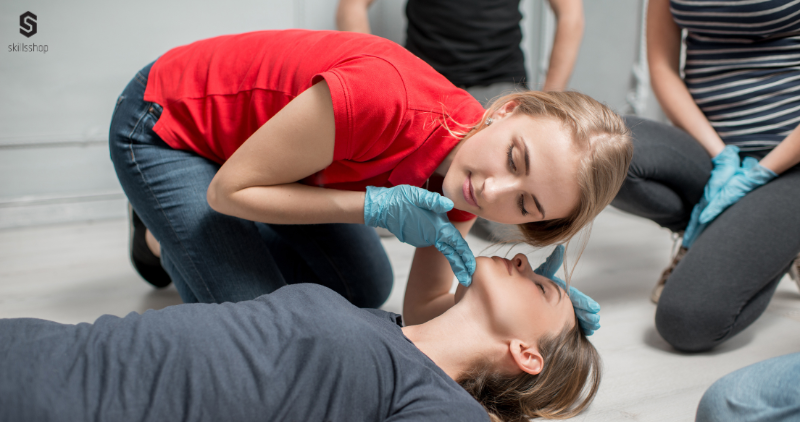
- Dealing with an unresponsive casualty
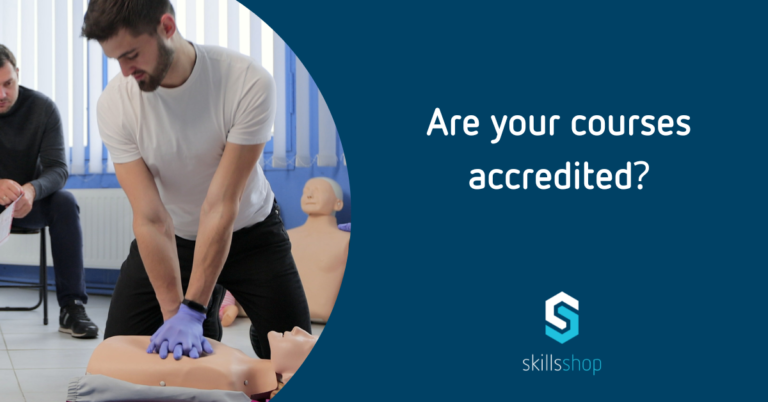
- Performing CPR & using a defibrillator
- Dealing with choking
- Course closure
- Dealing with minor injuries
At Skills Shop, we believe training should be practical, clear, and easy to understand.
We keep things simple so people feel confident, not overwhelmed.
Our courses are built around real workplaces, real situations, and real people.
That means less box ticking and more skills your team can actually use when it matters.
You’ll be supported by an experienced trainer who explains things in plain English, encourages questions, and makes sure everyone leaves knowing what to do and why it matters.
That’s why organisations choose Skills Shop.
Supportive. Honest. Open. Professional.
One of the main advantages of on-site training is that it allows participants to receive training in a familiar environment. This can help them feel more comfortable and confident during the training process.
It also eliminates the need for individuals to travel to a training venue. This saves time for those attending and helps your company reduce operating costs.
On-site training can also be tailored to the specific needs your company, making it a more effective and efficient way to deliver training.
Additionally, training on-site can help build a sense of community among participants. Your team are able to learn and practice together in a shared environment.
Similarly, training at a venue close by can offer many of the same benefits.
In addition a change of scenery and a break from the usual routine can aid productivity.
Overall, doing training on-site or at a nearby venue can be a convenient, effective, and cost-efficient way to develop new skills and knowledge. We deliver First Aid Awareness Training Course throughout the UK including: Birmingham, Bristol, Cardiff, Edinburgh, Glasgow, Leeds, Liverpool, London, Manchester, Newcastle, Nottingham, Sheffield, Southampton.
Face-to-face training and blended training are two distinct approaches to delivering training.
Face-to-face training involves participants physically attending training sessions in person.
This type of training provides direct interaction with the trainer and other participants, allowing for immediate feedback and the opportunity to ask questions and receive clarification in real-time.
On the other hand, blended training combines face-to-face training with online learning components, such as webinars, videos, and e-learning modules.
This approach allows participants to complete some aspects of the training remotely, typically on their own time and at their own pace.
The face-to-face component of blended training is typically shorter than traditional face-to-face training and usually focuses on practical application, skill-building, and group collaboration.
Overall, the choice between face-to-face training and blended training will depend on a variety of factors, including the specific learning goals, the needs of the participants, and the available resources.
Once you obtain this certification, it is valid for a period of three years.
This means that you can use your certification to demonstrate your skills and expertise for a full three years before needing to renew it.
However, it is important to note that you can renew your certificate up to 90 days before the expiry date.
This ensures that you maintain your certification and stay up-to-date with the latest best practices.
Renewing your certification is an easy process that typically involves attending a refresher course to refresh your skills and knowledge.
By keeping your certification current, you can continue to provide high-quality care and support to those in need.
Attending an annual refresher for is essential for ensuring that individuals remain competent and confident in dealing with a situation.
Individuals can refresh their knowledge and skills, learn about any updates or changes to best practices, and gain valuable practice in simulated emergency scenarios.
This can enhance an individual’s professional development and career opportunities, while also contributing to a safer and healthier workplace for all.
Contact us on 07563 246 110 to arrange your onsite refresher.
While many providers offer accredited courses that tend to follow a one-size-fits-all approach, we pride ourselves on delivering training that goes beyond the conventional. At Skills Shop, we believe that exceptional training should not be confined to the parameters of standard accreditation.
Instead, we focus on crafting bespoke, tailored training experiences that truly empower, educate, and engage every participant. Our courses are designed to meet the unique needs of individuals and organisations, ensuring practical, impactful learning outcomes.
Our courses however do follow a similar approach to accreditation following carefully designed session plans. You can view our Tutor Packs here >
Curious to learn how our personalised approach can benefit you or your business? Click here to discover more >
You choose the date and time
You choose the venue
No notes needed. Yours after training
Tailored, risk-free proposal provided
Summer is here so it’s critical to recognise the signs of heat exhaustion and heat stroke and know what to do.
Having the skills to save a life is a must but “which first aid course should I take?”
You may not know it but you could be one shop away from a latex allergic reaction.
Recognizing and responding to escalating student behaviour can be the key to preventing knife attacks in schools. From verbal threats to physical aggression and the alarming reality of knife attacks,
Explore the value of tailored courses: expert-led training beyond traditional standards
Summer is here so it’s critical to recognise the signs of heat exhaustion and heat stroke and know what to do.
Handy links